Walking the Highline Trail in Glacier National Park: A Morning Above the Garden Wall

Some trails you remember for the summit. The Highline is one I remember for the walking itself.
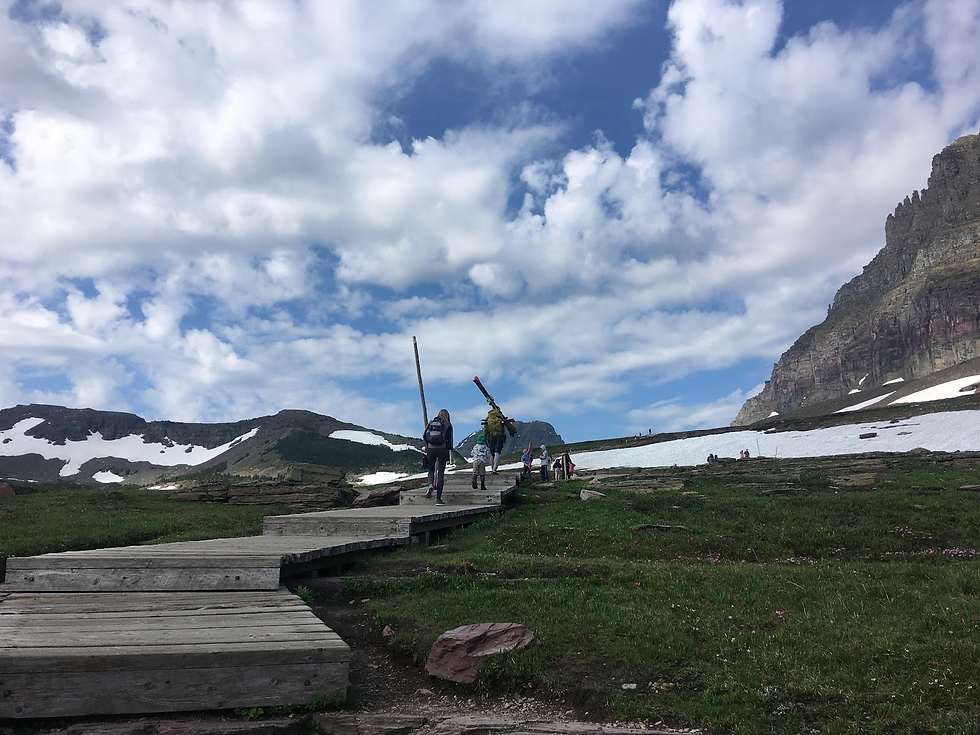
I started at Logan Pass just after the visitor center lot filled, which in Glacier means early. The pass sits at 6,646 feet, the highest point on the Going-to-the-Sun Road, right on the Continental Divide — the spine of the continent, where a raindrop landing on one side eventually drains toward the Pacific and on the other toward the Atlantic. The Highline Trail leaves from across the road and heads north along a limestone ridge the park calls the Garden Wall, and for the first stretch it is carved straight into the cliff, with a hand cable bolted to the rock for the nervous. I am, a little, so I held it.
What I didn't expect was the company. A mountain goat — unbothered, off-white, picking its way along a ledge no wider than my boot — stopped a few yards ahead and simply waited for me to work out the etiquette. (The etiquette is: you wait. They have better traction and more right to be there.) Below us the valley dropped away in that particular Glacier green, and the wildflowers the Garden Wall is named for were going strong: beargrass, paintbrush, the works.
A park named for leaving ice
Here's the part I keep turning over, though. This park is named for ice that is mostly leaving. At the end of the Little Ice Age, around 1850, roughly 80 glaciers sat in these mountains — each big enough to meet the size a body of ice has to reach before scientists will call it a glacier at all, about 25 acres, or 0.1 square kilometers. By 2005, the U.S. Geological Survey counted 32. That's a decline of nearly 60 percent, and USGS has documented that every named glacier in the park retreated between 1966 and 2015. From the Highline you can pick out a couple of the survivors clinging to shaded pockets along the divide, and knowing the arithmetic changes how you look at them.
I don't point that out to be grim. I say it because, standing there, it didn't feel like a headline — it felt like a place doing something slowly enough that we get to witness it. As a biologist I think a lot about baselines: the danger isn't only that things change, it's that we forget what they were. The goats will adapt or move on. The beargrass will follow the snow uphill. The ice, on its current course, has somewhere it's going.
If you go
The road over Logan Pass usually opens mid-to-late June and closes by mid-October, so the window is short. Start early, bring layers — the weather up there turns fast — and give the goats the trail. Walk it while it's this.
Find your wild.
Planning a park road trip with kids?
Long drives are part of every national park trip. I made the Screen-Free Road Trip Kit to turn the miles into part of the adventure: 35+ printable pages of road trip bingo, nature scavenger hunts, a Roadside Science Spotter, sketch prompts, and trip reflection pages for curious kids ages 7–12. Print it, pack it, and go.


Comments